Welcome to ScotRugby, a new blog I’ve started in order to keep track of the current state of the Scottish rugby player pool and our international and club squads.
I’ve been working on a way of ascertaining the positional depth of our teams and depicting that visually while incorporating elements of the selection process such as club and international form, coach preferences, previous international squad selections and positional versatility, as a means of presenting the international pecking order of the side as well as monitoring the implications of form for its selections.
Or, to paraphrase in simpler terms: if you know rugby union pretty well, then you’re probably aware of the depth chart, a way of depicting the strength of a team in each position.
The ScotRugby Chart is a version of that model.
What I’m going to be doing with this chart is updating it over the course of the season as players improve in form, are selected or dropped by Gregor Townsend, and receive injuries. And I’m going to be doing the same for Edinburgh Rugby and Glasgow Warriors.
So, without further ado, here’s the first ScotRugby Chart:
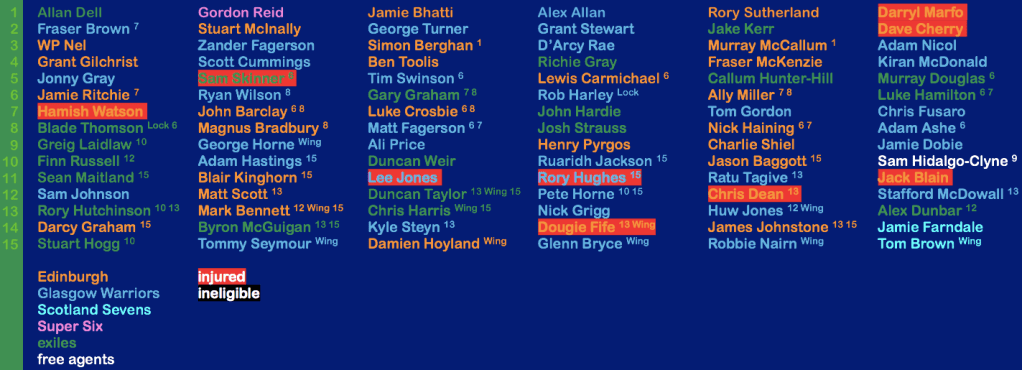
The ScotRugby Chart works on several basic rules:
- Begin with the most recent first-choice international XV played by Gregor Townsend.
At the time of writing, this is the side Scotland fielded against Japan in Yokohama in the 2019 Rugby World Cup. (If the match against Russia had been our final pool game, that team would not have been used as the XV for the ScotRugby Chart; this is because it was not a first-choice side. - Add in any first-choice players within the final squad for that tournament/series of internationals who were injured when this team was announced.
Hamish Watson almost certainly would’ve been in the team to face Japan had he been fit. He didn’t feature due to injury, rather than through being dropped in favour of another player (as applies to John Barclay and Ryan Wilson); therefore, he’s added to the top XV. - Fill out with the rest of the squad, in rough order of preference according to international selections.
Then do the same with a wider training squad if there was one – meaning every player who was involved in the summer pre-RWC warm-up games. - Add in any players who were injured when this squad was announced, but who featured in the PREVIOUS international squad named by Townsend.
The ScotRugby Chart only goes back two full squads – in this case, as far as the Scotland squad for the 2019 Six Nations. - Add in any other players from that previous squad.
- Fill out from the rest of the playing pool.
Edinburgh players, Glasgow Warriors players, exiles, the Sevens core contingent, and free agents (who must be Scotland internationals) all get added to the chart. - Alter rankings based on current club form.
– If a player overtakes another in the same position for his club, they’re swapped around on the chart – so Nick Grigg is ahead of Huw Jones, having been swapped with him.
– A player playing distinctly better than another from a different club in the same position overtakes them. This is why Mark Bennett is ahead of both Grigg and Jones. (This comes down to my own discretion.)
– Sometimes, this will necessitate a positional change. Rory Hutchinson has been outperforming Chris Harris in the Premiership at #13; he was originally listed as a #12 here, but I moved him (and Bennett) ahead of Harris due to their form (and Hutchinson’s ability to play in both positions). Similarly, I offset this by moving Duncan Taylor from #12 to #13 (he can also play in both positions). - It is always assumed that locks and wings can play in both #4/#5 shirts and #11/#15 shirts respectively, even if they have a preferred or stronger side.
The two jobs bring slightly different demands to them, but, realistically, most players can easily switch between the two.
I’ll be updating the ScotRugby Chart as pecking orders change, players improve in form, and international squads are chosen; this is a means of monitoring what form changes actually mean for a team going forward as well as keeping track of Scotland’s total positional depth over the same time period. And I’ll be doing the same for Edinburgh and Glasgow too.
That’s all for now – cheers for reading.
 ScotRugby